PNH Complement Inhibitors: Terminal C5 vs. Proximal C3, Factor B & Factor D
From 2007 to 2018, PNH patients had only one targeted option: intravenous eculizumab (Soliris) every 14 days. Between 2018 and 2024, the therapeutic landscape expanded into six distinct FDA/EMA-approved mechanisms spanning 8-week intravenous infusions, 4-week subcutaneous injections, twice-weekly C3 pumps, and twice-daily oral Factor B capsules.
Choosing or switching therapies requires weighing dosing convenience against extravascular hemolysis (EVH) control and the severity of breakthrough hemolysis (BTH) if a dose is missed.
Terminal C5 inhibitors (ravulizumab every 8 weeks IV, eculizumab every 2 weeks IV, and crovalimab every 4 weeks SC) block intravascular hemolysis and thrombosis. Proximal inhibitors targeting C3 (pegcetacoplan SC), Factor B (oral iptacopan monotherapy), or Factor D (oral danicopan add-on) prevent both intravascular and C3d-mediated extravascular hemolysis, normalizing hemoglobin in most patients.
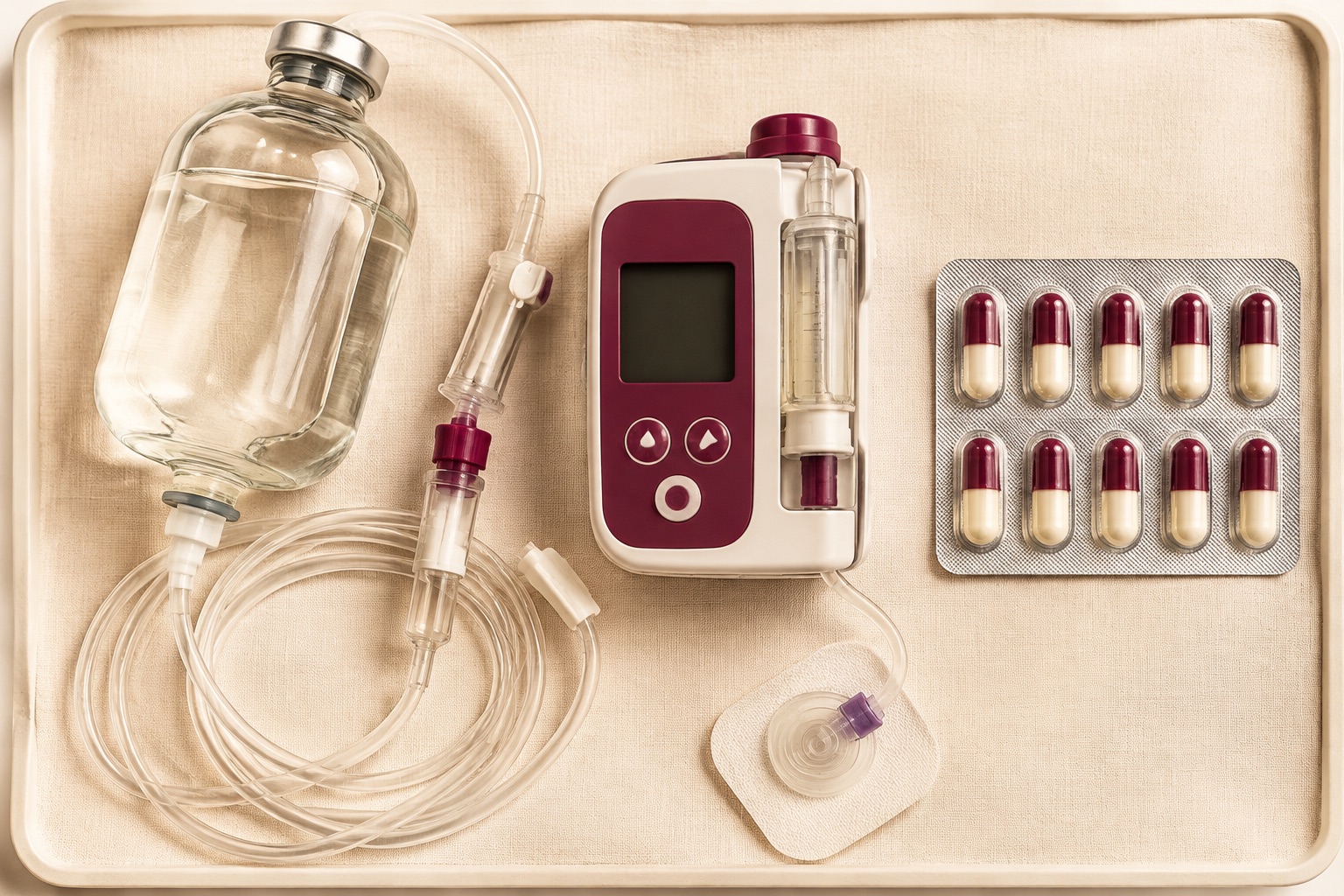
How Do Ravulizumab, Eculizumab, Pegcetacoplan, Iptacopan, Danicopan & Crovalimab Compare?
The table below synthesizes pivotal Phase 3 trial outcomes (Study 301/302, PEGASUS, PRINCE, APPLY-PNH, APPOINT-PNH, ALPHA, and COMMODORE 1/2) with real-world hematology prescribing rules.
| Drug & Approval | Target & Class | Route & Maintenance Schedule | Half-Life & EVH Protection | Pivotal Trial Outcomes & Clinical Niche |
|---|---|---|---|---|
| Ravulizumab Ultomiris (FDA 2018) |
TERMINAL C5 FcRn-recycled mAb |
IV infusion every 8 weeks (after Day 1 loading & Day 15 first maintenance) | Half-life ~50 days. Controls IVH; does not block C3d EVH (~25%-30% retain mild/moderate anemia). | First-line terminal standard: Non-inferior/superior to eculizumab in Studies 301/302 with 73% fewer infusions/yr (6-7/yr) and near-zero pharmacokinetic breakthrough hemolysis. |
| Eculizumab Soliris (2007) + Biosimilars Bkemv / Epysqli (2024) |
TERMINAL C5 Humanized mAb |
IV infusion every 2 weeks (900 mg maintenance after 4-week weekly induction) | Half-life ~11-12 days. Controls IVH; does not block C3d EVH. | Pregnancy & cost-access anchor: Deepest 18-year safety registry including pregnancy (Kelly et al. NEJM 2015). Biosimilars lower healthcare system cost where ravulizumab is unavailable. |
| Iptacopan Fabhalta (FDA Dec 2023) |
ORAL FACTOR B Proximal alternative pathway monotherapy |
Oral capsule: 200 mg twice daily (BID) with or without food | Half-life ~18-25 hours. Blocks both IVH and C3d EVH simultaneously. | Oral monotherapy breakthrough (APPLY-PNH & APPOINT-PNH): 82.3% of C5-treated anemic patients achieved +2 g/dL Hb rise (68.8% reached Hb >=12 g/dL) vs. 2% remaining on anti-C5. Requires strict twice-daily adherence. |
| Pegcetacoplan Empaveli / Aspaveli (FDA May 2021) |
PROXIMAL C3 PEGylated cyclic peptide (C3 & C3b) |
Subcutaneous (SC) infusion or injector: 1,080 mg twice weekly | Half-life ~8 days. Broadly blocks C3 cleavage, halting both IVH and EVH. | PEGASUS & PRINCE trials: Mean Hb increase of +2.37 g/dL over eculizumab (+3.84 g/dL total difference at Week 16), clearing C3d opsonization and normalizing reticulocytes. |
| Danicopan Voydeya (FDA Apr 2024) |
FACTOR D ADD-ON Proximal add-on to Ravulizumab or Eculizumab |
Oral tablet: 150 mg to 200 mg three times daily (TID) added onto background IV C5 inhibitor | Half-life ~7.9 hours. Dual proximal + terminal shield (C5 remains blocked if an oral dose is missed!). | ALPHA Trial: Designed specifically for the ~10%-20% of C5-treated patients with clinically significant EVH. Retaining background C5 blockade prevents severe intravascular BTH if oral doses are missed. |
| Crovalimab Piasky (FDA Jun 2024 / China 2024) |
TERMINAL C5 pH-dependent recycling mAb (distinct C5 epitope) |
Subcutaneous injection every 4 weeks (after 1 IV loading dose + weekly SC x4) | Half-life ~53-59 days. Effective in patients carrying the C5 Arg885His polymorphism. | COMMODORE 1/2/3: Low-volume SC self-injection once monthly; binds a different C5 beta-chain epitope than eculizumab/ravulizumab, rescuing the ~3.2% of East Asian patients resistant to Soliris/Ultomiris. |
The Proximal Paradox: Why Missing Oral or C3 Doses Carries a Higher Acute Hemolysis Risk Than C5 Monotherapy
Why doesn't every PNH patient immediately switch to a proximal monotherapy? Hematology specialists emphasize an essential biomechanical trade-off known as PNH RBC clone accumulation:
- On a Terminal C5 Inhibitor (Ravulizumab / Eculizumab): Because mild C3d-mediated extravascular clearance continues in the spleen, the circulating fraction of fragile Type III PNH red blood cells usually stabilizes between 50% and 70%. Furthermore, ravulizumab has a 50-day half-life.
- On Proximal Monotherapy (Iptacopan or Pegcetacoplan): Because both intravascular and extravascular destruction are completely shut down, nearly 100% of produced PNH red blood cells survive a full 120-day lifespan. Within 3 months, 90% to 98% of the patient's entire circulating red blood cell mass consists of CD55/CD59-deficient Type III cells.
- What Happens During a Missed Dose or Severe Infection: If a patient stops oral iptacopan (half-life ~20 hours) for several days during gastroenteritis, or experiences a massive complement-amplifying bacterial infection on pegcetacoplan without rescue intervention, that huge pool of unprotected Type III RBCs is exposed all at once to terminal C5b-9 lysis, risking a dramatic hemoglobin drop and acute kidney or thrombotic stress.
- How Dual Blockade (Danicopan + C5) or Rescue Protocols Solve This: For patients with high breakthrough risk or imperfect pill adherence, adding oral danicopan (Voydeya) on top of background 8-week IV ravulizumab controls EVH while maintaining continuous terminal C5 protection.
Frequently Asked Hematology & Patient Questions
Direct, link-free clinical answers grounded in ASH, IPIG, and Phase 3 complement inhibitor trial evidence.
Is Ultomiris (ravulizumab) better than Soliris (eculizumab) for PNH?
Yes, for most adult and pediatric patients requiring terminal C5 inhibition, ravulizumab (Ultomiris) is preferred over eculizumab (Soliris). Engineered with four amino acid substitutions that enhance neonatal Fc receptor (FcRn) recycling, ravulizumab extends the dosing interval from every 2 weeks to every 8 weeks (reducing annual infusions from 26 to 6 or 7) and eliminates the end-of-cycle pharmacokinetic breakthrough hemolysis seen in 10% to 15% of patients on standard-dose eculizumab.
Clinical source: Lee et al., Blood 2019 (Study 301); Kulasekararaj et al., Blood 2019 (Study 302).
When should a PNH patient switch from Ultomiris to Empaveli (pegcetacoplan) or Fabhalta (iptacopan)?
International PNH guidelines recommend evaluating a switch to proximal complement inhibition (oral iptacopan, subcutaneous pegcetacoplan, or add-on danicopan) when a patient has received stable terminal C5 inhibition for at least 3 to 6 months, has controlled intravascular hemolysis (LDH < 1.5x ULN), has ruled out bone marrow failure or iron/folate deficiency, yet still experiences symptomatic anemia (hemoglobin < 10.5 g/dL) with elevated reticulocytes and a positive C3d direct antiglobulin test.
Clinical source: Peffault de Latour et al., NEJM 2023 (APPLY-PNH) · See Living With PNH.
What happens if you temporarily stop taking a complement inhibitor?
Never stop a complement inhibitor abruptly without direct supervision from your PNH hematologist. Stopping terminal or proximal complement blockade allows complement activation to resume against accumulated GPI-deficient Type III red blood cells, triggering severe rebound intravascular hemolysis, acute hemoglobin drop, acute kidney injury, and life-threatening venous thrombosis. If switching between drugs, strict overlapping transition schedules must be followed.
Clinical source: Brodsky, Blood 2024 · See ER & BTH Guide.