✓ Medically Reviewed · ASH / IPIG Standard Updated: Independent · Zero Pharma Sponsorship
💙 A First Word If You Were Just Diagnosed Tonight

Take a breath. If you just read old search results saying Paroxysmal Nocturnal Hemoglobinuria (PNH) has a 10- to 15-year life expectancy, close those tabs. Those numbers come from before 2007, when targeted therapy did not exist. Today, with modern C5 and proximal complement inhibitors, life expectancy for PNH patients matches age-matched people without the disease.

PNH Flow Cytometry, Complement Inhibitors & Survival Atlas

Why does a flow cytometry lab report show a 68% PNH clone in granulocytes but only an 18% clone in red blood cells? And why do 25% to 35% of patients on intravenous C5 inhibitors normalize their LDH yet still feel exhausted with a hemoglobin of 9.1 g/dL? Select where you are in your PNH journey below to go straight to the answers and tools built for your next hematology visit.

Key Clinical Takeaways (ASH / IPIG Evidence Standard)

Paroxysmal nocturnal hemoglobinuria (PNH) is an acquired somatic PIGA stem cell disorder in which blood cells lack glycosylphosphatidylinositol (GPI) anchor proteins CD55 and CD59. Unchecked complement activation lyses red blood cells and triggers venous thrombosis. Modern terminal C5 and proximal C3, Factor B, and Factor D inhibitors restore near-normal life expectancy.

Automated benchtop clinical laser flow cytometer with sealed lavender EDTA blood specimen tubes in a sunlit hospital hematology laboratory
Diagnostic Gold Standard: High-Sensitivity Peripheral Blood Flow Cytometry (FLAER · CD55 · CD59)
Step 2 · Interactive Hospital Lab Slip to Plain-English Doctor's Note

My PNH Lab & Symptom Translator + Doctor Visit Sheet Generator

Click one of the 4 real-world patient examples below or enter your own lab numbers on the left. On the right, your bedside translation updates live with your LDH multiple gauge, granulocyte vs. RBC clone discrepancy explanation, C3d extravascular hemolysis check, and a printable 3-question sheet for your hematologist.

🩺 Interactive PNH Lab Slip & Bedside Consultation Workspace

Instant Client-Side Calculation · Zero Data Stored
Load Patient Example:
📋 Left Side: Your Hematology Lab Slip (Enter Numbers)
🩺 Right Side: Plain-English Doctor's Note & Visit Checklist
Intravascular Hemolysis (LDH / ULN Ratio): 6.20x ULN Goal on therapy: <1.5x ULN
1.0x Normal 1.5x IVH Threshold 3.0x Moderate 5.0x Severe 8.0x+ Crisis

Active Intravascular Hemolysis (LDH >= 1.5x ULN & clone >= 10%): Free hemoglobin is actively scavenging nitric oxide (driving fatigue and thrombotic risk). This meets international clinical thresholds to start or optimize terminal C5 or proximal complement blockade.

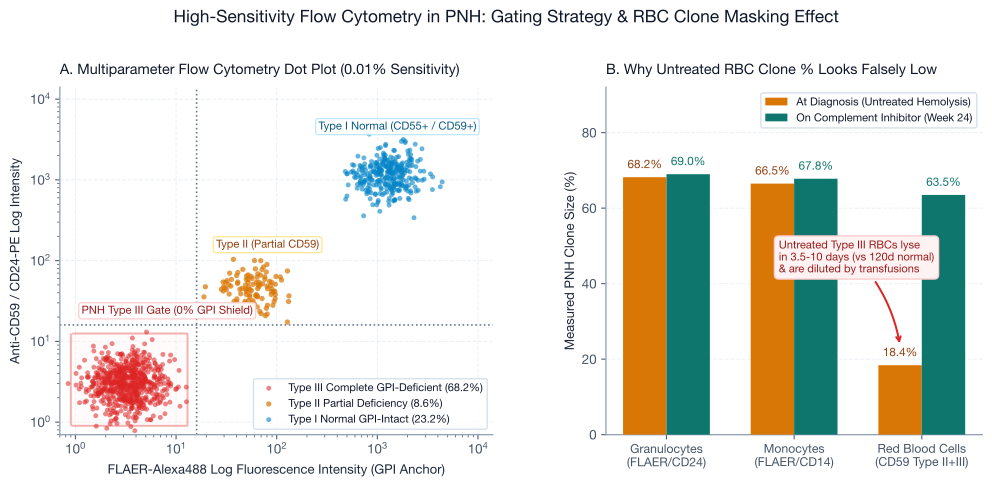
Clone Discrepancy Explained: Your granulocyte clone (68%) is much higher than your measured RBC clone (18%). Granulocytes show your true bone marrow PNH stem cell burden; the RBC number looks artificially low because fragile Type III red cells burst early or are diluted by transfusions.

📋 Suggested Questions for Your Next Hematology Appointment:
  1. With my LDH at 6.20x ULN and a 68% granulocyte clone, should we initiate a long-acting C5 inhibitor (Ultomiris / Piasky) or a proximal inhibitor (oral Fabhalta / SC Empaveli)?
  2. Can we order my quadrivalent MenACWY and serogroup B (MenB) vaccines today, and use oral antibiotic prophylaxis if we need to start therapy urgently?
  3. Should we check baseline ferritin, folate, and renal function before starting complement blockade?
Step 1 · Modern Life Expectancy & Flow Cytometry Clone Science

Why Modern PNH Life Expectancy Matches Healthy Adults & How Flow Cytometry Works

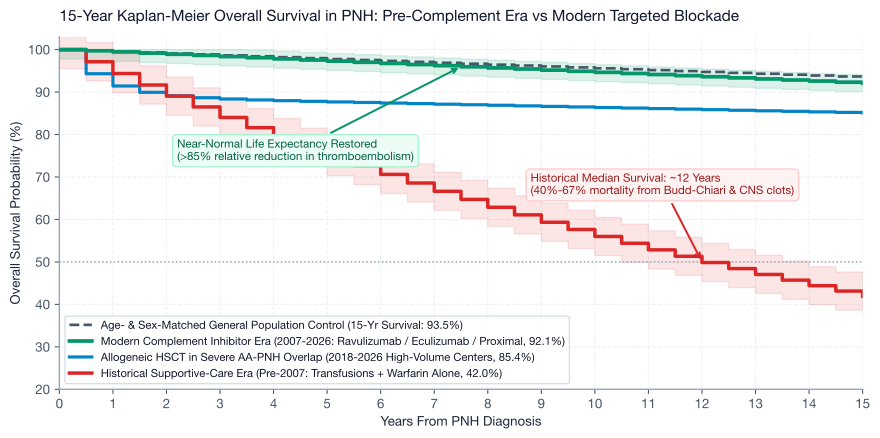
Before 2007, unchecked intravascular hemolysis and venous blood clots limited median survival to 10 to 15 years. Today, blocking the complement cascade restores 15-year survival to match age-matched general population controls, while protecting fragile Type III red blood cells from premature lysis:

15-year Kaplan-Meier overall survival curves in PNH comparing pre-2007 supportive care era versus modern complement inhibitor era matching general population survival
Figure 1 · 15-Year Kaplan-Meier Overall Survival in PNH: Modern complement inhibition restores long-term survival (>92% at 15 years) to match age- and sex-matched general population controls. Sources: Kelly et al., Blood 2011; Kulasekararaj et al., Ann Hematol 2025.
Two-panel flow cytometry diagnostic chart showing 2D log-scale FLAER vs CD59 scatter plot of Type I, II, and III cell populations and bar chart of granulocyte versus red blood cell clone size before and after complement blockade
Figure 2 · High-Sensitivity Multiparameter Flow Cytometry & RBC Clone Masking: Untreated Type III red cells burst within 3.5 to 10 days (vs. 120 days normal), making the untreated RBC clone (18.4%) look much smaller than the true granulocyte clone (68.2%). Source: Borowitz et al., Cytometry Part B 2010.

Interactive Guide · 60-Second Flow Cytometry Granulocyte Clone Bracket Decoder

Click Your Granulocyte FLAER Clone Percentage Bracket

Granulocyte FLAER Clone >=50%: Classic Hemolytic PNH & High Thrombotic Risk

Terminal C5 Blockade Or Proximal C3 / Factor B
Laboratory & Clinical Profile of Classic Large-Clone PNH (>=50% Granulocytes)
Diagnostic Parameter Typical Untreated Finding Why This Happens in Your Blood Goal on Complement Therapy
Granulocyte & Monocyte FLAER 50% to 99% GPI-deficient True measure of PIGA stem cell dominance in bone marrow (white cells do not lyse from complement). Clone % stays high; therapy protects red blood cells from bursting rather than erasing the marrow clone.
RBC CD59 (Type III) Clone Often 15% to 45% (falsely low) Type III RBCs lack CD59 entirely and burst inside blood vessels (C5b-9 MAC) or are diluted by transfusions. Type III RBC % climbs toward your granulocyte % once therapy keeps your red blood cells alive!
Serum LDH (Lactate Dehydrogenase) 3.0x to 10.0x ULN (>750 to 2,500+ U/L) Direct marker of intravascular hemolysis (IVH) and cell-free hemoglobin spilling into plasma. <1.5x ULN (normal or near-normal), cutting venous blood clot risk by >85%.
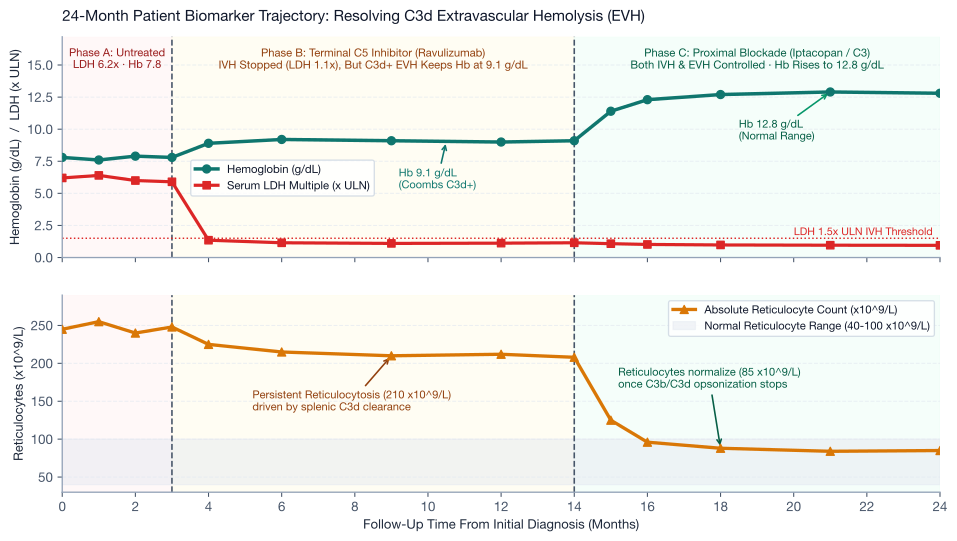
Reticulocytes & Direct Coombs (C3d) Reticulocytes >120 x 10^9/L; Coombs negative pre-treatment Bone marrow working overtime. On C5 inhibitors, surviving RBCs can accumulate surface C3d tags. If Hb stays <10.5 g/dL with high reticulocytes & C3d+ on C5 therapy, discuss proximal C3/Factor B/D blockade.
Step 3 · Interactive 2026 Complement Therapy Matcher & EVH Solutions

Compare All 6 Approved PNH Drugs by Your Lifestyle, Genetics & Hemoglobin Goals

Why does terminal C5 blockade stop intravascular hemolysis yet leave extravascular anemia in 25% to 35% of patients? Filter all 6 FDA/EMA/NMPA-approved complement inhibitors below by what matters most to your daily life:

Ultomiris (Ravulizumab)
Terminal C5
Dosing: IV infusion once every 8 weeks (6-7 infusions/year).
  • Best For: First-line IVH & thrombosis protection with 50-day half-life and minimal clinic visits.
  • Limitation: ~25%-30% retain mild/moderate C3d extravascular anemia.
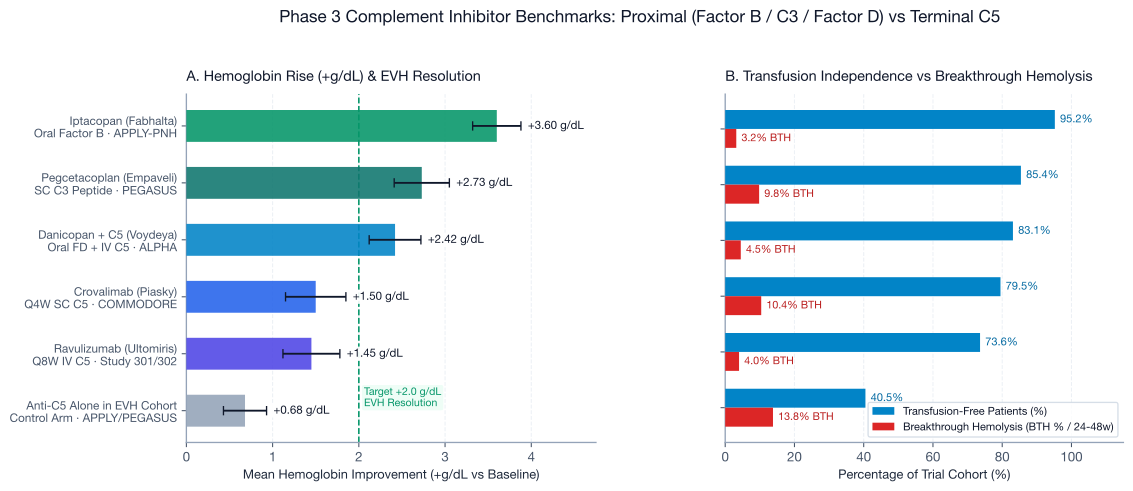
Study 301/302 · 73.6% Transfusion-Free
Fabhalta (Iptacopan)
Oral Factor B
Dosing: Oral capsule 200 mg twice daily (BID) monotherapy.
  • Best For: Needle-free oral monotherapy that resolves both IVH and C3d EVH (+3.60 g/dL Hb rise).
  • Safety Rule: Short 20h half-life; never miss doses!
APPLY-PNH · 95.2% Transfusion-Free
Empaveli (Pegcetacoplan)
Proximal C3
Dosing: Subcutaneous pump/injector 1,080 mg twice weekly.
  • Best For: Broad C3 blockade clearing C3d opsonization and raising Hb by +2.73 g/dL in C5-anemic patients.
  • Safety Rule: Have intensive rescue plan for infections.
PEGASUS / PRINCE · 85.4% Transfusion-Free
Voydeya (Danicopan + C5)
Factor D Add-On
Dosing: Oral tablet 150-200 mg 3x daily added to Ultomiris/Soliris.
  • Best For: Dual proximal + terminal shield: resolves C3d EVH (+2.42 g/dL Hb) while background C5 blocks severe BTH if a pill is missed.
ALPHA Trial · 83.1% Transfusion-Free
Piasky (Crovalimab)
Terminal C5 SC
Dosing: Subcutaneous self-injection once every 4 weeks.
  • Best For: Home SC injection every 4 weeks; binds distinct C5 beta-chain epitope (rescues East Asian C5 Arg885His carriers!).
COMMODORE 1/2/3 · 79.5% Transfusion-Free
Soliris & Biosimilars
Eculizumab
Dosing: IV infusion 900 mg every 2 weeks (includes Bkemv & Epysqli).
  • Best For: Gold-standard maternal/pregnancy registry and lower-cost biosimilar access.
TRIUMPH · 18-Year Safety Registry
24-month longitudinal biomarker chart tracking Hemoglobin, Serum LDH multiple, and Reticulocyte count across untreated intravascular hemolysis, terminal C5 blockade with C3d extravascular hemolysis, and proximal Factor B/C3 blockade
Figure 3 · 24-Month Patient Biomarker Trajectory (IVH vs. C3d Extravascular Hemolysis): Starting a terminal C5 inhibitor at Month 3 drops LDH from 6.2x to 1.1x ULN, yet Hemoglobin plateaus at 9.1 g/dL due to C3d splenic clearance. Switching to proximal blockade at Month 14 normalizes Hemoglobin to 12.8 g/dL. Sources: Hillmen et al., NEJM 2021; Peffault de Latour et al., NEJM 2023.
Phase 3 complement inhibitor clinical trial benchmarks comparing mean hemoglobin increase and transfusion-avoidance rates across Iptacopan, Pegcetacoplan, Danicopan, Crovalimab, and Ravulizumab
Figure 4 · Head-to-Head Phase 3 Complement Inhibitor Outcomes: Mean hemoglobin change from baseline (+3.60 g/dL Iptacopan, +2.73 g/dL Pegcetacoplan, +2.42 g/dL Danicopan) and transfusion-free rates across APPLY-PNH, PEGASUS, ALPHA, and COMMODORE trials. See Full 6-Drug Comparison Matrix.
Step 4 · Complete Clinical & Patient Navigation Directory

Explore All 8 Core PNH Guides & Decision Tools

Every guide is written in warm, plain language, anchored to peer-reviewed trials and guidelines, and mirrored across English, Spanish, and Simplified Chinese.

01. Flow Cytometry & Renal CT/MRI Decoder

CD55 · CD59 · FLAER

Why granulocyte FLAER clone size differs from RBC clone size, Type I/II/III red cell populations, and why chronic hemolysis causes the renal cortical hemosiderosis rim sign on CT and MRI.

Gold Standard
High-sensitivity flow cytometry (0.01% threshold)
Legacy Archive
Includes CT & MRI Renal Hemosiderosis Concordance
Open Flow Cytometry & CT Guide ->

02. Compare All 6 Approved Complement Inhibitors

2026 Drug Matcher

Interactive head-to-head comparison of Ravulizumab (Ultomiris), Eculizumab (Soliris & biosimilars), Pegcetacoplan (Empaveli), Iptacopan (Fabhalta), Danicopan (Voydeya), and Crovalimab (Piasky).

Key Trade-Off
8-week IV convenience vs. oral/SC extravascular control
Safety Rule
Strict adherence prevents rebound breakthrough hemolysis
Open 6-Drug Matcher & Trial Matrix ->

03. Living With PNH: Fatigue, Iron & Vaccines

Daily Companion

Managing nitric-oxide-depletion fatigue, why unmonitored iron supplementation triggers hemolytic crises when starting therapy, travel checklists, and MenACWY + MenB schedules.

Historical Anchor
Preserves the 2007-2021 Living With PNH Patient Brochure
Vaccine Mandate
MenACWY + MenB boosters & penicillin rules
Open Living With PNH Guide ->

04. Thrombosis & Breakthrough Hemolysis ER Guide

Emergency Triage

Budd-Chiari hepatic vein thrombosis, portal/mesenteric clots, cerebral venous sinus thrombosis, and how to manage infection-triggered breakthrough hemolysis (BTH).

Red-Flag Symptoms
Acute abdominal pain, severe headache, dysphagia, fever
Clinic Tool
Printable ER Physician Communication Card
Open ER Triage Protocol ->

05. Aplastic Anemia (AA) & MDS Overlap

Marrow Failure

Why 40% to 50% of acquired aplastic anemia patients harbor a PNH clone, the autoimmune T-cell escape mechanism, and sequencing ATG + cyclosporine + eltrombopag with complement blockade.

Overlap Rate
40%-50% in AA; 15%-20% in hypoplastic MDS
Treatment Rule
Distinguish marrow failure anemia from hemolytic anemia
Open AA-PNH Overlap Guide ->

06. Pregnancy, Contraception & Surgery

Maternal & Peri-Op

Why estrogen contraception is contraindicated, NEJM evidence for eculizumab safety in pregnancy, LMWH anticoagulation through 6 weeks postpartum, and pre-surgical dosing.

Maternal Survival
Improved from 80%-92% historically to >99% on C5 blockade
Postpartum Rule
Mandatory 6-week postpartum LMWH anticoagulation
Open Maternal & Surgery Guide ->

07. Global Drug Access, Biosimilars & HSCT

Global Access

Comparing $450,000-$550,000/yr US list prices, FDA/EMA eculizumab biosimilars (Bkemv, Epysqli), UK NHS national commissioning, Latin America, and China NRDL reimbursement + HSCT centers.

Biosimilars
Eculizumab biosimilars Bkemv & Epysqli (2024-2026)
Global Systems
US REMS · UK NHS · EU · LatAm · China NRDL & HSCT
Open Global Access Matrix ->

08. PNH Support Group Archive (2003-2021)

18-Year Archive

Concordance of historical PNH Support Group resources, verified international patient advocacy organizations (AAMDSIF, PNH Support UK, HPN Espana, AAMAC), and editorial methodology.

Provenance
2003-2021 PNH Support Group historical concordance
Editorial Desk
About & Disclosures · Evidence Updates
Open Support Archive ->
🏛️ Our 18-Year Patient Sanctuary Story (2003-2026)

From 2003 to 2021, PNHdisease.org operated as the primary online sanctuary and educational library of the North American PNH Support Group, cited by Johns Hopkins Medicine Kimmel Cancer Center, Orphanet, and AAMDSIF. Rebuilt in 2026 as a sponsor-free trilingual hematology companion, we preserve every historical patient guide while integrating modern C5 and proximal C3/Factor B/D clinical evidence. Explore our 18-Year PNH Support Group Archive.

Common Questions from Patients & Families

Frequently Asked Questions from Patients & Families

Clear, compassionate answers grounded in ASH guidelines, IPIG consensus, and Phase 3 complement inhibitor clinical trials.

Is Paroxysmal Nocturnal Hemoglobinuria (PNH) a form of leukemia or cancer?

No. PNH is not leukemia or a malignant cancer, and it never metastasizes to solid organs. It is a benign acquired clonal disorder of hematopoietic stem cells caused by a somatic mutation in the PIGA gene. However, because PNH shares deep bone marrow biology with aplastic anemia and myelodysplastic syndrome (MDS), a small minority of patients (roughly 2% to 5% over 10 years) can evolve into MDS or acute myeloid leukemia, requiring regular complete blood count monitoring.

Clinical source: Parker et al., Blood 2005 (IPIG Consensus) · See AA & MDS Overlap.

What CD markers are used to diagnose PNH on flow cytometry?

Laboratories diagnose PNH using high-sensitivity multiparameter flow cytometry on peripheral blood. In red blood cells, testing measures the GPI-anchored complement regulators CD55 and CD59 to classify cells into Type I (normal), Type II (partial deficiency), and Type III (complete deficiency). In white blood cells (granulocytes and monocytes), laboratories combine FLAER (fluorescently labeled inactive aerolysin, which binds directly to the GPI anchor) with lineage markers such as CD15, CD24, CD14, and CD64.

Clinical source: Borowitz et al., Cytometry Part B 2010 · See Flow Cytometry Decoder.

What is the life expectancy of someone with PNH on modern complement inhibitors?

Before the approval of eculizumab in 2007, median survival after a PNH diagnosis was 10 to 15 years, with venous thrombosis accounting for up to two-thirds of deaths. Today, long-term registry studies from the UK, US, and Europe demonstrate that PNH patients treated with terminal C5 inhibitors (eculizumab or ravulizumab) or proximal complement inhibitors who do not have severe underlying bone marrow failure achieve a life expectancy matching age-matched healthy controls.

Clinical source: Kelly et al., Blood 2011; Kulasekararaj et al., Ann Hematol 2025.

Why do only 25% of PNH patients actually notice dark urine at night or in the morning?

Although the disease was named in the 19th century for dark morning urine (caused by mild respiratory acidosis during sleepenhancing complement activation and concentrated overnight urine), chronic low-grade intravascular hemolysis occurs 24 hours a day. Roughly 70% to 75% of newly diagnosed patients present with crushing fatigue, anemia, smooth muscle spasms, or unexplained thrombosis rather than visible macroscopic hemoglobinuria.

Clinical source: Brodsky, NEJM 2014 / Blood 2021 Review · See Living With PNH.